


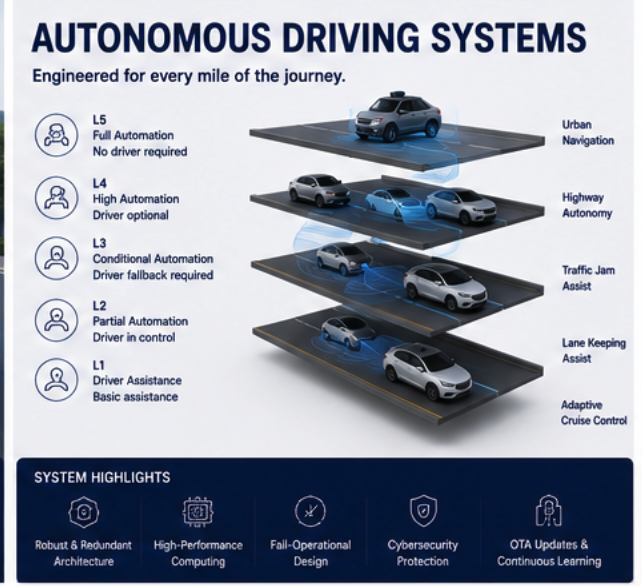
Before vehicles can drive themselves, they must learn to assist. Advanced Driver Assistance Systems (ADAS) represent the incremental integration of automation into everyday vehicles. Features like automatic emergency braking, lane keeping assist, and adaptive cruise control are not just convenience features—they are the building blocks of Self-Driving Vehicle Technology. Each ADAS feature adds a layer of capability, reducing driver workload and preventing accidents. Understanding ADAS is essential for appreciating both the current state of automotive safety and the roadmap to full autonomy.
What Are Advanced Driver Assistance Systems?
ADAS refers to electronic systems that assist the driver in the driving process. Unlike fully autonomous systems (which replace the driver), ADAS augments the driver. The driver remains responsible for the vehicle at all times.
Key characteristics of ADAS:
-
Partial automation: The system handles specific tasks (e.g., maintaining speed, staying in lane).
-
Driver monitoring: The driver must remain engaged and ready to intervene.
-
Safety focus: Most ADAS features are designed to prevent accidents or reduce severity.
-
Incremental deployment: Features are added gradually, building trust and capability.
The Sensor Suite for ADAS
Advanced Driver Assistance Systems (ADAS) use a subset of the sensors found in fully autonomous vehicles:
| Sensor | Typical Location | ADAS Applications |
|---|---|---|
| Forward camera | Windshield (behind rearview mirror) | Lane departure, traffic sign recognition, auto high beams |
| Front radar | Grille or front bumper | Adaptive cruise control, automatic emergency braking |
| Rear camera | Tailgate or trunk | Rearview camera, cross-traffic alert |
| Rear radar | Rear bumper (corners) | Blind spot monitoring, rear cross-traffic alert |
| Ultrasonic | Bumpers (parking sensors) | Parking assist, automatic parking |
| Driver monitoring camera | Steering column or dash | Driver attention warning |
Entry-level ADAS might use only a front camera. Premium systems add radar for better performance in poor weather.
Key ADAS Features and Their Functions
Self-Driving Vehicle Technology is built from these foundational ADAS features:
Adaptive Cruise Control (ACC):
-
Function: Maintains set speed and following distance from the vehicle ahead. Automatically slows and accelerates.
-
Sensors: Front radar and/or camera.
-
Driver benefit: Reduces fatigue on highway drives.
-
Limitation: ACC cannot stop for stationary objects (e.g., a stopped queue of cars). The driver must intervene.
Automatic Emergency Braking (AEB):
-
Function: Detects imminent collision and applies brakes automatically if the driver does not react.
-
Sensors: Front radar and camera.
-
Driver benefit: Reduces rear-end collisions by 50% or more.
-
Limitation: AEB is designed to reduce severity, not always prevent collision entirely. Effectiveness decreases at high speeds.
Lane Keeping Assist (LKA) and Lane Departure Warning (LDW):
-
LDW: Alerts the driver (visual, audible, or haptic) if the vehicle drifts out of its lane without a turn signal.
-
LKA: Gently steers the vehicle back into the lane if drifting.
-
Sensors: Forward camera (detects lane markings).
-
Driver benefit: Prevents unintended lane departure (e.g., due to fatigue or distraction).
-
Limitation: Both require clear lane markings. Performance degrades in poor lighting or weather.
Blind Spot Monitoring (BSM):
-
Function: Alerts the driver (typically a light in the side mirror) when a vehicle is in the blind spot. Some systems provide audible warning if the turn signal is activated.
-
Sensors: Rear corner radar.
-
Driver benefit: Reduces lane-change collisions.
Rear Cross-Traffic Alert (RCTA):
-
Function: Warns the driver of approaching vehicles when reversing out of a parking space.
-
Sensors: Rear corner radar.
-
Driver benefit: Prevents backing collisions, particularly in crowded parking lots.
Driver Monitoring System (DMS):
-
Function: Uses an inward-facing camera to detect driver distraction, drowsiness (eye closure, head position), and seatbelt status.
-
Sensors: Camera (often infrared for night operation).
-
Driver benefit: Alerts the driver when attention wanders; can escalate to audible alarms and brake interventions.
Traffic Sign Recognition (TSR):
-
Function: Reads speed limit signs, stop signs, and other traffic signs. Displays them to the driver; may integrate with ACC to adjust speed.
-
Sensors: Forward camera.
-
Driver benefit: Keeps driver informed; helps avoid speeding tickets.
Automatic High Beams (AHB):
-
Function: Detects oncoming traffic and vehicles ahead, automatically switching between high and low beams to avoid blinding other drivers.
-
Sensors: Forward camera.
-
Driver benefit: Maximizes nighttime visibility without manual switching.
The ADAS Hierarchy: Level 1 and Level 2 Automation
ADAS features correspond to SAE Levels 1 and 2:
Level 1 (one feature at a time):
-
The vehicle assists with steering OR braking/accelerating, but not simultaneously.
-
Example: Adaptive cruise control (braking/accelerating) with separate lane departure warning (steering).
Level 2 (combined features):
-
The vehicle assists with steering AND braking/accelerating simultaneously.
-
Example: Tesla Autopilot, GM Super Cruise, Ford BlueCruise. The vehicle maintains speed, following distance, and lane centering on highways.
Level 2+ (enhanced Level 2):
-
Marketing term for Level 2 systems with advanced capabilities (automated lane changes, navigation-guided driving).
-
Still Level 2: the driver must monitor the environment at all times.
How ADAS Prevents Accidents
The primary purpose of Advanced Driver Assistance Systems (ADAS) is accident prevention. Data from the Insurance Institute for Highway Safety (IIHS) shows significant benefits:
| Feature | Reduction in Relevant Crashes |
|---|---|
| Automatic emergency braking (AEB) | 50% reduction in rear-end crashes |
| Lane departure warning (LDW) | 21% reduction in lane-departure crashes |
| Blind spot monitoring (BSM) | 14% reduction in lane-change crashes |
| Rearview camera | 17% reduction in backing crashes |
| Adaptive cruise control (ACC) | 10-20% reduction in rear-end crashes (when used) |
Limitations of Current ADAS
Despite their benefits, Self-Driving Vehicle Technology via ADAS has significant limitations:
Environmental sensitivity:
-
Cameras are degraded by direct sun, fog, heavy rain, and snow.
-
Radar is less affected but has lower resolution.
-
Lane markings must be visible for lane keeping systems.
Driver over-reliance ("Automation Complacency"):
-
Studies show drivers trust Level 2 systems too much, engaging in distracting activities (using phones, reading).
-
Fatal accidents have occurred when drivers failed to monitor the system.
System Limitations:
-
Most AEB systems do not detect pedestrians or cyclists (though some newer systems do).
-
Stationary object detection (e.g., a stopped truck on the highway) remains challenging.
-
Unprotected left turns and complex intersections are beyond current ADAS.
The Transition from ADAS to Autonomy
Advanced Driver Assistance Systems (ADAS) are not just safety features; they are the on-ramp to full autonomy. Each feature adds sensing and actuation capability. The progression is:
-
ADAS (Level 1-2): Driver assistance, driver responsible.
-
Conditional autonomy (Level 3): Vehicle drives under specific conditions; driver must be available to take over.
-
High autonomy (Level 4): Vehicle drives under specific conditions; no driver needed.
-
Full autonomy (Level 5): Vehicle drives anywhere, anytime.
The sensors, algorithms, and actuation systems developed for ADAS are directly transferable to higher levels of autonomy.
The Future of ADAS
The Self-Driving Vehicle Technology market continues to evolve:
-
Regulatory mandates: AEB will be required on all new US passenger vehicles by 2029. The EU already requires AEB, LDW, and driver monitoring.
-
More capable sensors: Higher-resolution cameras, 4D imaging radar, and cheaper LiDAR are entering ADAS systems.
-
Enhanced driver monitoring: Cabin cameras with eye tracking and hands-on-wheel detection.
-
Navigation-guided ADAS: Integration with GPS/maps for predictive speed adjustment (e.g., slow for upcoming curves).
-
Over-the-air updates: ADAS features can be improved after vehicle purchase.
Conclusion
You may not own a self-driving car, but you almost certainly own a car with Advanced Driver Assistance Systems (ADAS). These features are making driving safer today while simultaneously building the technological foundation for Self-Driving Vehicle Technology. From automatic emergency braking to lane keeping assist, each ADAS feature is a step toward the autonomous future. The road to Level 5 is paved with Level 2 bricks—and we are already driving on it.

 English
 Arabic
 French
 Spanish
 Deutsch
 Turkish
 Dutch
Dutch
 Italiano
 Russian
 Romaian
 Portuguese (Brazil)
 Greek
Greek