


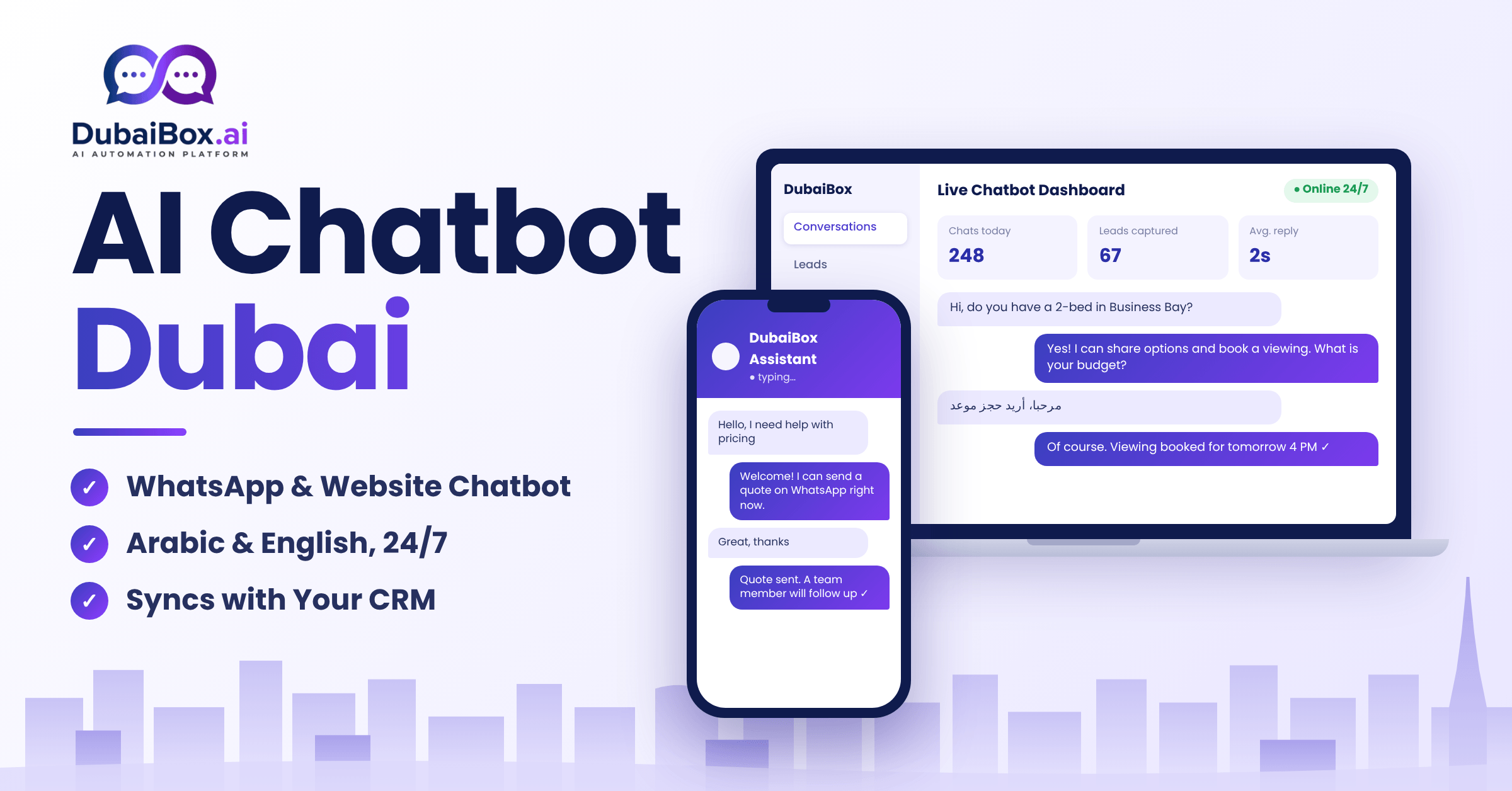
For businesses in Dubai, responding quickly to customer enquiries can influence whether a visitor becomes a paying customer or chooses another provider. When enquiries arrive through websites, messaging apps, and online campaigns, managing every conversation manually can place pressure on sales and support teams. An AI chatbot Dubai solution helps businesses handle these interactions by answering common questions, collecting useful information, and guiding customers towards suitable services.
Unlike a basic chat window that displays fixed answers, an AI-powered chatbot can interpret natural language and respond according to the context of a conversation. Depending on its configuration, it may recommend products, qualify leads, help customers navigate a website, or connect them with an employee. The most effective implementations focus on specific business needs rather than trying to automate every customer interaction.
What Makes an AI Chatbot Different?
Traditional chatbots usually rely on fixed rules. They may ask a series of questions and display predefined responses based on the options a user selects. AI chatbots can interpret more varied wording, allowing customers to ask questions in a conversational way.
For example, a customer might type, "I need a meeting next week, preferably in the afternoon." An AI chatbot can identify the request as an appointment enquiry and ask for the information needed to proceed.
However, conversational ability does not automatically give a chatbot access to live business information. Checking availability, processing an order, or changing a booking requires a suitable connection to the relevant system.
How the Technology Processes Requests
An AI chatbot receives a message, interprets the likely intent, and generates a response using its model, instructions, and available information. Some systems also search a company knowledge base before answering.
More advanced implementations connect to business applications through integrations or APIs. This allows the chatbot to retrieve approved information or initiate specific actions under controlled permissions.
Businesses should define what the chatbot can do independently and which requests require staff approval.
Why Dubai Businesses Can Benefit from AI Chatbots
Dubai has a varied business landscape, with companies serving local residents, international customers, tourists, and corporate clients. Customers may prefer different communication channels and languages, while businesses often need to manage enquiries across several departments.
An AI chatbot Dubai service can provide a consistent first point of contact and help direct customers to the information they need.
Serving Customers Across Different Time Zones
Companies working with international clients may receive enquiries outside local office hours. A chatbot can provide basic information, explain service procedures, and collect details for follow-up.
For example, a business consultancy could use its website chatbot to explain its services and ask visitors which type of support they require. The team can review the enquiry when available rather than losing it in an unattended inbox.
Supporting Multilingual Communication
Businesses serving Dubai's diverse population may need to communicate in Arabic and English, alongside other languages relevant to their customers.
Some AI chatbot platforms support multiple languages, but performance varies. Companies should test common phrases, regional expressions, spelling variations, and conversations that switch between languages. Language support should be evaluated through real examples rather than a provider's feature list alone.
Practical Uses of an AI Chatbot Dubai Solution
1. Website Enquiry Management
A chatbot can help website visitors find information without searching through multiple pages. It can answer approved questions about services, business hours, locations, and processes.
For a professional services firm, it might explain the difference between available packages and direct visitors to the appropriate enquiry form. This makes the website more useful while reducing repetitive questions received by staff.
2. Sales Lead Qualification
Sales teams need to understand what a potential customer wants before recommending a service. A chatbot can ask a short series of relevant questions and organise the answers for follow-up.
A property company, for example, might ask visitors whether they want to rent or purchase, which area they prefer, and their approximate budget. The information can help an agent prepare for the next conversation.
Lead qualification should remain straightforward. Asking too many questions or requesting unnecessary personal information may cause visitors to abandon the conversation.
3. Customer Support and Order Enquiries
Businesses can use chatbots to answer common support questions, explain return procedures, or retrieve order updates when connected to suitable systems.
For example, an online retailer may allow customers to enter an order reference and receive a status update. The chatbot should verify access permissions before displaying personal order information.
Complex complaints, payment disputes, and unusual requests should be transferred to trained support staff.
4. Appointment Requests
Clinics, salons, consultants, and service providers can use chatbots to collect preferred dates, explain booking requirements, and assist with scheduling.
When connected to a live calendar, the system may show available time slots and create appointments. Without that integration, it should collect a request and explain that confirmation will follow. This distinction prevents customers from assuming that a proposed time is already reserved.
5. Messaging-Based Customer Engagement
Some businesses want to support customers through messaging platforms such as WhatsApp. Depending on the provider and approved integration, a chatbot may answer incoming messages, share business information, and route enquiries to employees.
Companies should confirm which messaging features are supported, whether template or opt-in requirements apply, and how customer conversations are recorded and managed.
How AI Chatbots Improve Business Efficiency
Reduced Repetitive Work
Customer service employees often answer the same questions throughout the day. Automating suitable requests gives staff more time for complex cases, relationship building, and tasks that require professional judgement.
The goal is not to remove human support. It is to ensure employees spend less time repeating basic information and more time solving problems.
More Structured Customer Information
A chatbot can collect enquiry details in a consistent format. When connected to a CRM, it may create a lead record, assign a category, or notify the appropriate team.
This can make follow-up easier, but businesses should check for incomplete or inaccurate records. Staff need clear ownership of incoming leads so that useful enquiries do not remain unattended.
Measurable Customer Service Performance
Businesses can assess chatbot performance using practical measures such as response time, enquiry completion, lead conversion, successful handovers, and customer satisfaction.
A high number of automated conversations does not necessarily mean the chatbot is effective. The more useful question is whether customers receive correct answers and complete the tasks they came to perform.
Choosing the Right AI Chatbot for Your Business
Identify the Primary Goal
Before selecting a platform, decide what needs improvement. A business might want to reduce support tickets, collect more qualified leads, improve website navigation, or streamline appointment requests.
Begin with one or two high-value use cases. A focused rollout is easier to test and refine than a complicated system introduced across every department at once.
Review Integrations and Customisation
Check whether the chatbot works with the business's website, CRM, appointment calendar, help desk, or messaging platform. Ask whether information can be updated by authorised staff without rebuilding the entire system.
Also establish what happens if an integration fails. The chatbot should explain the limitation and provide a practical alternative instead of returning inaccurate information.
Compare Total Cost and Support
Costs may include setup, monthly subscriptions, message usage, integration work, maintenance, and additional language support. Compare these expenses with expected improvements in lead handling and staff productivity.
Ask the provider about technical support, security controls, data export, service availability, and contract terms before committing.
Challenges and Important Considerations
AI chatbots can misunderstand vague questions, produce incorrect answers, or struggle with situations outside their intended scope. These risks are greater when the knowledge base contains outdated information or the system has not been tested against real customer conversations.
Businesses should review failed interactions, update answers regularly, and provide an easy route to human assistance. Sensitive decisions should remain under appropriate human oversight.
Data protection also matters. Companies should understand what information is collected, where it is stored, who can access it, and how long it is retained. Businesses operating in Dubai should assess the UAE data protection requirements applicable to their activities and any relevant industry-specific obligations.
Frequently Asked Questions
1. What is an AI chatbot Dubai service?
It is an AI-powered conversational tool that helps businesses in Dubai respond to enquiries, provide information, collect leads, and automate selected customer service tasks.
2. Can an AI chatbot support Arabic and English?
Some platforms support both languages. Businesses should test response quality, regional wording, and language switching before choosing a solution.
3. Can an AI chatbot connect to WhatsApp?
Some providers offer integrations with WhatsApp Business. Available features depend on the platform, account configuration, and applicable messaging policies.
4. Is an AI chatbot suitable for small businesses?
Yes. Small businesses can start with website FAQs, lead collection, or appointment requests. A focused setup can deliver value without requiring extensive automation.
5. How can a business measure chatbot success?
Useful measures include the accuracy of answers, completed enquiries, lead conversion, response times, customer satisfaction, and the number of conversations successfully handed over when needed.
Conclusion
An AI chatbot Dubai solution can help businesses improve online communication, manage customer enquiries, organise sales leads, and automate selected tasks. Its value depends on the accuracy of its information, the quality of its integrations, and the ease with which customers can reach a person when necessary.
Businesses should begin with a clear objective, test the chatbot using realistic scenarios, and measure outcomes after launch. With regular maintenance, suitable privacy safeguards, and a reliable human handover process, an AI chatbot can become a practical tool for improving customer experience and operational efficiency.

 Arabic
 French
 Spanish
 Portuguese
 Deutsch
 Turkish
 Dutch
Dutch
 Italiano
 Russian
 Romaian
 Portuguese (Brazil)
 Greek
Greek