


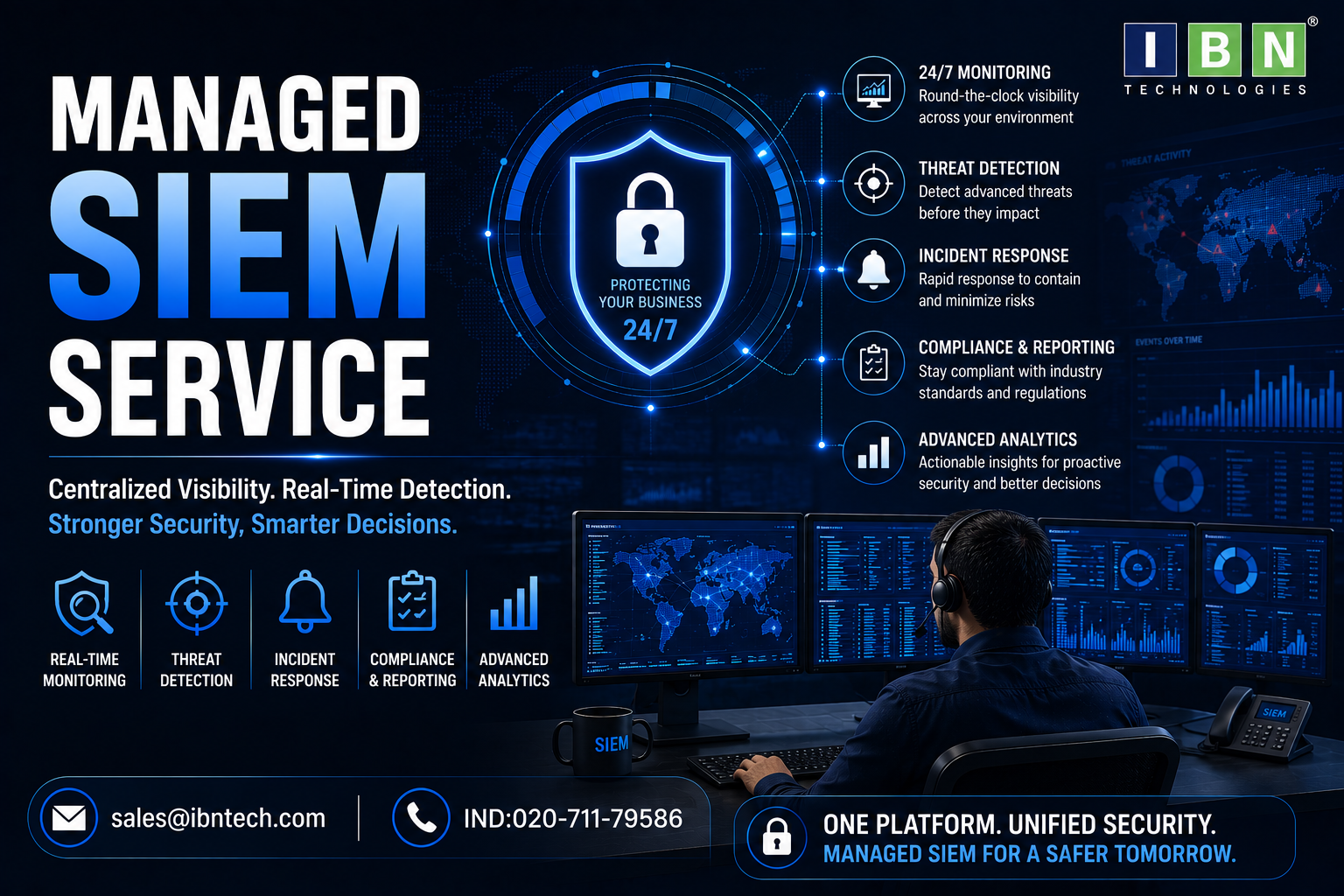
Protecting Connected Healthcare Systems With Managed SIEM Service in India
A managed SIEM service helps hospitals collect and analyze security events from clinical, administrative and infrastructure systems so suspicious activity can be identified and investigated. For Indian healthcare organizations, managed SIEM service can support continuous security visibility while helping internal IT teams coordinate monitoring, escalation and incident response across complex environments.
Why healthcare security needs broader visibility
Clinical dependency: Modern hospitals depend on digital systems for patient registration, diagnostic workflows, pharmacy operations, billing, communication and clinical records. A security incident affecting one connected system can create consequences beyond the IT department.
Security monitoring therefore needs to consider both conventional infrastructure and healthcare-specific technology. An isolated view of servers or endpoints may not provide enough context when activity crosses multiple systems.
Distributed environment: Hospitals often operate a mixture of on-premises infrastructure, cloud applications, connected devices, remote access and third-party services. Each environment can produce different security events.
A centralized monitoring approach helps security teams establish a more consistent view of activity across these environments.
Compliance should shape the monitoring model
Healthcare organizations need to consider privacy, information security, access governance and incident management as part of their broader control environment. Security monitoring can support these activities, but monitoring alone does not establish compliance.
For hospitals evaluating a managed soc service for Indian hospitals, the assessment should include how security events are handled, documented, escalated and reviewed.
Information handling: Logs can contain sensitive technical or user-related information. Their collection, access and retention should be governed appropriately.
Access oversight: Privileged access to clinical and administrative systems should receive particular attention because misuse can affect sensitive information and operational continuity.
Incident records: Hospitals should maintain appropriate records of significant security investigations and response actions according to their internal governance requirements.
Control alignment: Monitoring processes should complement existing information security policies rather than operate as an isolated technical function.
Where traditional monitoring falls short
A hospital's IT team may already review system alerts, antivirus notifications and infrastructure events. The difficulty arises when these signals remain separated across different consoles or are reviewed only when staff have time.
Healthcare operations also run around the clock. Security events can occur while the primary IT team is handling clinical technology issues, infrastructure maintenance or other operational priorities.
How does a managed soc service for Indian hospitals support compliance?
A managed soc service for Indian hospitals can provide a defined process for reviewing security events, escalating suspicious activity and maintaining operational visibility. The exact scope should be established according to the hospital's systems, policies and security requirements.
This approach can help separate continuous monitoring responsibilities from decisions that require internal authorization, clinical context or management involvement.
A practical security workflow for hospitals
Collect: Relevant events are identified from endpoints, servers, network infrastructure, identity systems, applications and other important technology assets.
Correlate: Related events can be examined together instead of being treated as unrelated alerts. This helps analysts understand whether separate activities may form part of the same security incident.
Investigate: Suspicious patterns require contextual analysis. For example, an unusual administrative login becomes more important if followed by unexpected access to sensitive systems.
Escalate: Defined procedures determine which incidents require notification to hospital IT leaders, security personnel or other responsible stakeholders.
Review: Monitoring rules and procedures should evolve when infrastructure changes, recurring false positives appear or investigations reveal new security requirements.
Which healthcare systems deserve monitoring attention?
Hospitals should prioritize systems according to their operational and information-security risk rather than applying identical monitoring to every asset.
Important areas may include:
- Identity and access management systems.
- Servers supporting clinical and administrative applications.
- Network infrastructure connecting critical departments.
- Endpoints used by staff and administrators.
- Cloud services containing organizational information.
- Security devices and remote access infrastructure.
- Systems supporting patient-facing digital services.
A managed SIEM service can help bring relevant events from these environments into a structured monitoring process.
What should Indian hospitals monitor through a managed soc service?
Indian hospitals should focus on events involving privileged accounts, unusual authentication, suspicious endpoint activity, unauthorized configuration changes and access to sensitive systems. Monitoring priorities should reflect the hospital's architecture and the consequences associated with each system.
For example, a privileged account accessing a sensitive application at an unusual time may warrant investigation, particularly when accompanied by other unexpected activity.
Compliance does not replace operational judgment
Context matters: A security alert is not automatically a confirmed incident. Healthcare teams need operational context to determine whether activity is expected.
Ownership matters: External monitoring can identify and escalate suspicious events, but the hospital should retain responsibility for decisions involving systems, users, access and remediation.
Documentation matters: Security operations should make it possible to understand what was detected, what was investigated and what action followed.
Testing matters: Hospitals can periodically review escalation procedures using realistic scenarios such as compromised credentials, suspicious privileged access or unusual activity against a clinical application.
Evaluating a healthcare monitoring arrangement
A hospital considering managed monitoring should examine the following areas before agreeing to a service model:
| Evaluation area | Key consideration |
| Log coverage | Which systems and devices will be monitored? |
| Alert handling | How are alerts reviewed and prioritized? |
| Escalation | Who receives notifications and under what conditions? |
| Data protection | How are collected security records protected? |
| Access control | Who can view or manage monitoring information? |
| Incident support | What happens when suspicious activity is confirmed? |
| Reporting | What operational information is provided to internal teams? |
| Responsibilities | Which actions remain with the hospital? |
This evaluation is especially useful when hospitals have multiple facilities or a mixture of legacy and modern systems.
Healthcare scenario: protecting availability as well as information
Imagine a hospital where an administrator's credentials are used to access several systems outside the person's normal workflow. One isolated event might not provide enough information to determine whether the activity is malicious.
When authentication records, endpoint events and application activity are considered together, the security team can investigate the broader sequence. The goal is to identify potentially harmful behavior early while avoiding unnecessary disruption to clinical operations.
Can managed soc service for Indian hospitals work with existing IT teams?
Yes. A managed service can be structured around defined responsibilities, allowing hospital IT personnel to retain ownership of business systems while the monitoring function handles agreed security operations.
The exact division should be documented before implementation so that an alert does not become an ownership dispute during an active incident.
What should healthcare leaders ask about managed soc service for Indian hospitals?
They should ask about monitored assets, alert escalation, data handling, incident workflows, reporting, access controls and the responsibilities of internal staff. These questions reveal how the service would operate during an actual security event rather than only during normal conditions.
Does a managed SIEM service make a hospital compliant?
No. It can support monitoring and security-control activities, but compliance depends on the organization's complete governance framework, applicable requirements, policies and implementation of controls.
FAQ
Can SIEM monitoring cover both clinical and corporate systems?
Yes, where the relevant systems can provide appropriate security telemetry and are included within the monitoring scope. Coverage should be designed around the hospital's architecture and risk priorities.
Is continuous security monitoring useful for smaller hospitals?
It can be, particularly when internal teams have limited capacity for continuous alert review. The appropriate service scope depends on the hospital's technology environment, risks and operational requirements.
Should hospital IT teams retain control of incident response?
They should retain clearly defined authority over business-impacting actions and remediation. A managed monitoring function can support detection, analysis and escalation without removing internal accountability.
IBN Technologies can support organizations evaluating managed IT and cybersecurity service requirements for complex healthcare environments.
Contact Us
IBN Technologies
Phone: +91 20 6768 0404
Email: sales@ibntech.com

 English
 Arabic
 French
 Spanish
 Portuguese
 Deutsch
 Turkish
 Dutch
 Russian
 Romaian
 Portuguese (Brazil)
 Greek