


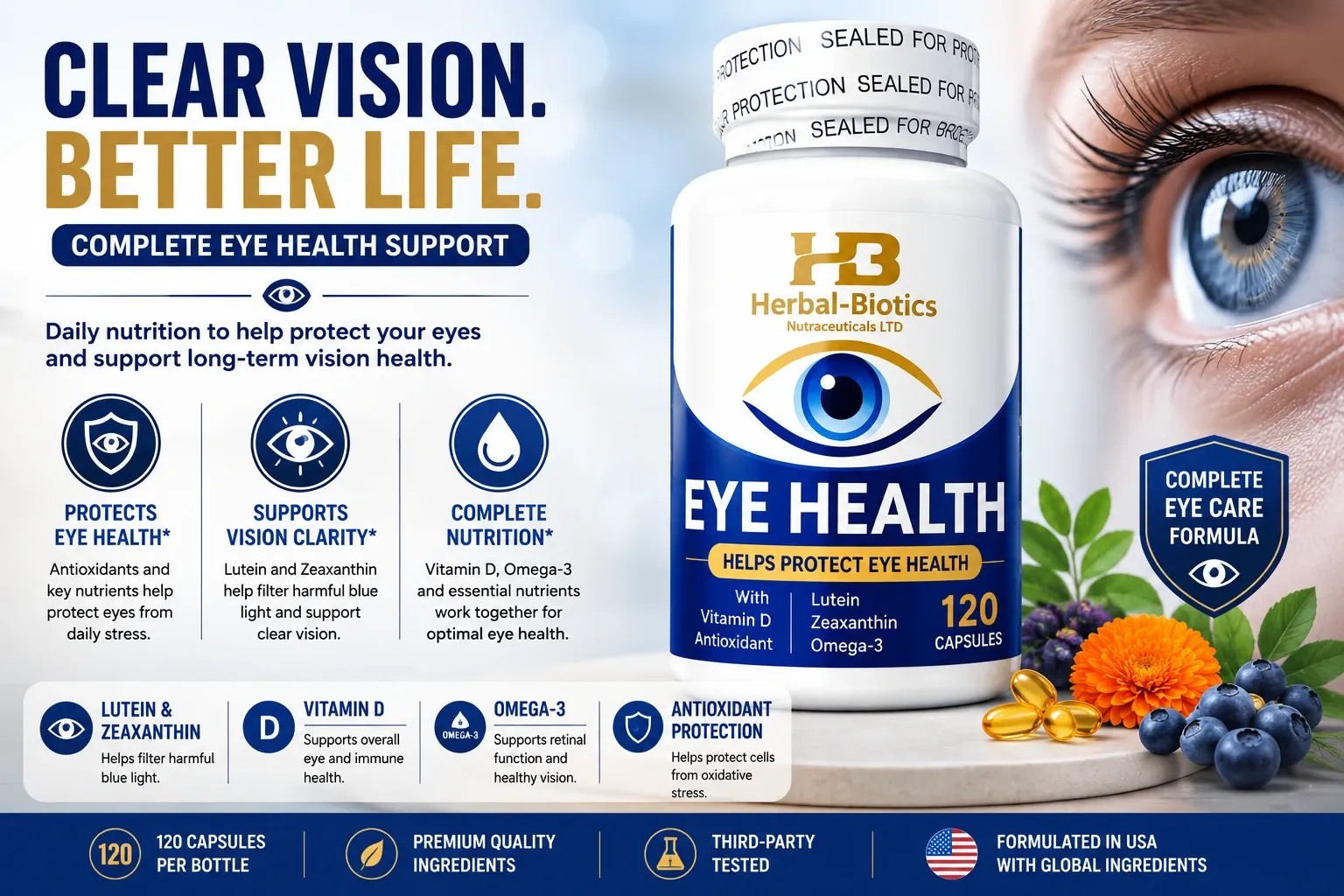
An Eye Health Care Supplement is generally used to provide selected vitamins, minerals, antioxidants, carotenoids, or other nutrients that are associated with maintaining healthy eyes. People take these products for different reasons.
Some want general nutritional support, while others have been advised to use a specific formulation such as an Eye Health Care Supplement because they have an eye condition such as certain stages of age-related macular degeneration (AMD).
Common ingredients include lutein, zeaxanthin, vitamins C and E, zinc, copper, vitamin A, and sometimes beta-carotene. These nutrients do not all serve the same purpose, and the amount in a product matters just as much as the ingredient itself.
This distinction is important because an ordinary Milk Thistle Liver Detox Supplement is not automatically a treatment for an eye disease. Specialized formulations such as AREDS2 are different. They were studied in people with particular stages of AMD and can help slow progression in appropriate patients. They are not intended for everyone.
The simplest way to think about an eye supplement is this: it can provide nutritional support, but it is not a replacement for glasses, eye examinations, prescription treatment, or surgery when those things are needed.
What Is an Eye Health Care Supplement?
An eye-health supplement is a dietary supplement formulated around nutrients that have some connection with normal eye function or the maintenance of eye tissues. Some products are broad nutritional formulas containing several vitamins and minerals. Others are much more targeted, containing nutrients such as lutein and zeaxanthin or following an evidence-based AREDS2 formulation.
The label "eye vitamins" can therefore be misleading if it makes every product sound equivalent. Two supplements sold for eye health may contain completely different ingredients and doses, and they may have very different purposes.
What Do Eye Health Supplements Contain?
Common eye health nutrients include lutein and zeaxanthin, two carotenoids found in the retina, along with vitamin C, vitamin E, zinc, copper, vitamin A, or beta-carotene. Some formulas also contain other nutrients marketed for particular concerns, including dry-eye support.
The presence of an ingredient does not automatically prove that the finished product will prevent or treat an eye condition. Evidence has to be considered for the particular nutrient, dose, combination, and health situation.
Why Do People Take Eye Health Supplements?
People often take supplements because they are concerned about getting enough nutrients through food, have an unbalanced diet, are getting older, or have been told that a particular nutrient is relevant to eye health. Someone may also become interested after hearing about lutein, zeaxanthin, antioxidants, or AREDS2.
There is nothing inherently wrong with that interest. The mistake is assuming that taking more nutrients necessarily produces better vision. Nutrition matters, but the eye is not a machine that responds to increasingly large doses of vitamins.
Are Eye Supplements the Same as Eye Medicines?
No. Dietary supplements and medicines have different roles. A supplement supplies nutrients, while an eye medicine is specifically used to diagnose, manage, or treat a medical condition under appropriate professional guidance.
For example, supplements do not correct nearsightedness or farsightedness. They also should not replace glaucoma medication, treatment for wet AMD, cataract surgery, or other clinically appropriate care.
What Is Eye Health Care Supplement Used For?
The main use of an Eye Health Care Supplement is nutritional support. What that means in practice depends heavily on the formulation and the person taking it.
Supporting General Eye Health
"Supporting eye health" should mean more than a vague promise on a bottle. The eyes require a steady supply of nutrients because the retina and other eye tissues are metabolically active. Vitamins and minerals contribute to normal cellular functions, antioxidant systems, and normal vision.
A supplement can help supply selected nutrients, particularly when someone's diet does not provide enough. That does not mean the supplement will produce a noticeable improvement in eyesight. Nutritional adequacy and sharper vision are two different things.
Providing Eye-Supporting Nutrients
Supplements can provide concentrated amounts of nutrients that would otherwise be obtained from food. Lutein and zeaxanthin are particularly common in eye-health formulas because they are present in the retina and macula.
Other ingredients, including vitamins C and E and zinc, are used in certain clinically studied formulations. The important point is that the evidence applies to particular combinations and situations, not automatically to every product containing one of those ingredients.
Supporting Macular Health
The macula is the central part of the retina responsible for detailed central vision. Lutein and zeaxanthin are concentrated in the macula, where they are thought to have antioxidant functions and help filter some high-energy light.
That makes them interesting nutrients for macular health, but it would be an overstatement to say that taking lutein or zeaxanthin prevents every form of macular disease. Their role is more specific than that.
Supporting Certain Stages of Age-Related Macular Degeneration
This is where supplements have some of their strongest clinical evidence. The AREDS and AREDS2 studies found that particular high-dose combinations can slow progression of AMD in people at appropriate stages of the disease. The National Eye Institute states that AREDS2 may benefit people with intermediate AMD and certain people with late AMD in one eye.
That does not make AREDS2 a general-purpose eye vitamin. It is a specialized formulation for a specific clinical situation.
Addressing Nutritional Gaps
A supplement can also be useful when there is a genuine nutritional gap. Someone whose diet is limited or who has particular nutritional needs may have a reason to consider supplementation.
Still, the sensible approach is to ask what nutritional problem is actually being addressed. Taking a product simply because it is labeled "eye health" is much less meaningful than knowing what the product contains and why those nutrients are relevant.
What Ingredients Are Found in Eye Health Supplements?
Lutein
Lutein is a carotenoid found naturally in foods such as leafy green vegetables. It is also concentrated in the retina and macula. Because of this, lutein is one of the most recognizable ingredients in modern eye health supplements.
Its presence in AREDS2 is especially important. AREDS2 uses lutein together with zeaxanthin as a replacement for beta-carotene in the formulation studied for AMD.
Zeaxanthin
Zeaxanthin is closely related to lutein and is another carotenoid found in the retina. Together, lutein and zeaxanthin are often described as macular pigments.
Their inclusion in supplements makes sense from a biological and research perspective, but that should not be confused with a guarantee that supplementation will make normal vision sharper.
Vitamin C
Vitamin C is an essential nutrient with antioxidant functions. It appears in the AREDS and AREDS2 formulations at a much higher amount than people would typically get from a standard multivitamin.
That high dose is part of a specific research-tested combination. It should not be interpreted as evidence that everyone needs large amounts of vitamin C for better eyesight.
Vitamin E
Vitamin E is another antioxidant nutrient included in AREDS and AREDS2. Like vitamin C, its relevance to AMD comes from its role as part of a specific formulation rather than from evidence that taking vitamin E alone prevents common eye diseases.
More is not automatically better. High-dose supplementation should have a reason behind it.
Zinc
Zinc is an essential mineral involved in many biological processes. It was included in the original AREDS formulation, where the combination of antioxidants and zinc helped reduce the risk of progression to advanced AMD in people at higher risk.
The amount used in AREDS is substantially higher than ordinary nutritional requirements. That is one reason an AREDS2 product should not be treated like a generic daily multivitamin.
Copper
Copper is included alongside zinc in AREDS and AREDS2. This is not an accidental extra ingredient. High supplemental zinc can interfere with copper status, so copper was included to help reduce the risk of copper deficiency associated with the formulation.
Vitamin A and Beta-Carotene
Vitamin A has a fundamental role in normal vision because the retina needs vitamin A-related compounds to detect light. A deficiency can therefore cause serious problems with normal visual function.
Beta-carotene is a carotenoid that the body can use to make vitamin A. However, taking large amounts of beta-carotene is not a shortcut to better eyesight.
Beta-carotene also deserves special attention in smokers and former smokers. The original AREDS formula contains beta-carotene, but AREDS2 replaced it with lutein and zeaxanthin because beta-carotene was associated with increased lung cancer risk in people who smoke or previously smoked. The newer AREDS2 formulation does not contain beta-carotene.
How Do Eye Health Supplements Support Vision?
There is an important difference between supporting eye health and improving eyesight.
Do Eye Supplements Make Vision Sharper?
Usually, you should not expect an eye supplement to make your vision suddenly sharper. Refractive errors such as nearsightedness, farsightedness, and astigmatism are related to how light is focused by the eye. Vitamins do not reshape the eye to correct those problems.
That is why supplements should not be presented as an alternative to glasses or contact lenses. If your vision is blurry because you need a new prescription, an eye examination is far more useful than simply adding another bottle of vitamins.
Can They Restore Lost Vision?
Supplements generally cannot restore vision that has already been permanently lost because of retinal damage, advanced glaucoma, an established cataract, or another structural problem.
There are important nuances. In AMD, for example, AREDS2 can help slow progression for certain people, which can help preserve vision for longer. Slowing further damage is not the same thing as reversing damage that has already occurred.
Do They Support Long-Term Eye Health?
Potentially, depending on the nutrient, formulation, and individual. The strongest example is the specific AREDS2 formulation for appropriate AMD patients.
For general eye nutrition, the picture is less dramatic. Adequate nutrition supports normal body and eye function, but that does not mean every person will benefit from taking a high-dose supplement.
Are Eye Health Supplements Used for Macular Degeneration?
What Is Age-Related Macular Degeneration?
Age-related macular degeneration is a disease affecting the macula, the central part of the retina responsible for detailed central vision. As AMD progresses, people can develop problems such as blurred or distorted central vision and, in advanced disease, significant central vision loss.
AMD has different stages and forms, so saying someone "has AMD" does not tell you enough to know whether an eye supplement is appropriate.
What Are AREDS and AREDS2?
AREDS stands for Age-Related Eye Disease Study. AREDS and AREDS2 were major clinical studies sponsored by the National Eye Institute that examined whether particular vitamin and mineral combinations could affect the progression of AMD.
The original AREDS formulation contained vitamin C, vitamin E, zinc, copper, and beta-carotene. AREDS2 replaced beta-carotene with lutein and zeaxanthin. The newer formulation is particularly important for people who smoke or used to smoke because of the lung cancer concern associated with beta-carotene.
Who May Benefit From AREDS2?
The benefit depends on the stage of AMD. According to the National Eye Institute, AREDS2 may help people with intermediate AMD in one or both eyes and may help people with late AMD in one eye by slowing progression in the other eye. It does not provide the same established benefit for people without AMD or those with early AMD.
This is one of the most important distinctions in the entire subject. If an eye doctor recommends AREDS2, that recommendation is based on the person's retinal findings, not simply their age or interest in eye vitamins.
Can AREDS2 Prevent AMD?
No. AREDS2 is not a universal prevention supplement. The evidence shows that it can slow progression in appropriate people who already have certain stages of AMD. It does not mean that someone without AMD can take AREDS2 and guarantee that they will never develop the disease.
Can AREDS2 Reverse Vision Loss?
No. The purpose is to reduce the risk of progression to more advanced AMD, not to restore damaged retinal tissue.
This distinction is easy to miss in supplement advertising. "Helps slow progression" is a very different claim from "improves eyesight." AREDS2 belongs in the first category.
Are Eye Health Supplements Used for Cataracts?
Cataracts occur when the normally clear lens of the eye becomes cloudy. Because cataracts are associated with aging and oxidative processes, it is understandable that people search for vitamins and supplements that might prevent or reverse them.
However, evidence does not support treating an established cataract with an ordinary eye supplement. The AREDS research also found no overall effect of the original formulation on cataract development or progression.
Nutrition is still relevant to overall health, but a supplement should not be marketed as a way to dissolve or reverse a cataract. When cataracts begin interfering with reading, driving, work, or everyday activities, an eye-care professional can determine whether monitoring or cataract surgery is appropriate.
Are Eye Health Supplements Used for Glaucoma?
Glaucoma is a group of eye diseases that can damage the optic nerve, often in association with elevated eye pressure, although eye pressure is not the only factor involved. Because glaucoma can progress without obvious symptoms, diagnosis and monitoring are important.
An eye-health supplement should not be treated as glaucoma medication. There is not a general vitamin formula that can replace eye-pressure monitoring, prescribed medicines, laser treatment, surgery, or other treatment recommended by an eye specialist.
Some nutrients have been studied in relation to glaucoma, but interesting research is not the same thing as established treatment. If someone has glaucoma, supplement decisions should be discussed in the context of their actual diagnosis and treatment plan.
Can Eye Health Supplements Help With Dry Eyes?
Dry-eye symptoms are another reason people search for supplements. Omega-3 fatty acids and other nutrients are commonly marketed for this purpose, partly because inflammation and the health of the tear-producing system are involved in dry-eye disease.
The evidence, however, is not simple or universally positive. Studies of nutritional supplements for dry eye have produced mixed findings, and the usefulness of a supplement can depend on the underlying cause of the symptoms.
Persistent burning, irritation, fluctuating vision, or a gritty feeling deserves more than a supplement experiment. Dry eye can be related to medications, eyelid problems, screen habits, environmental exposure, contact lenses, autoimmune conditions, or other factors. Finding the cause is often more useful than assuming a vitamin deficiency is responsible.
Who May Consider Taking an Eye Health Supplement?
People Looking for Nutritional Support
Someone with a generally poor or restricted diet may reasonably discuss whether supplementation makes sense. The first question, though, is whether the diet can be improved.
Leafy greens, colorful vegetables and fruits, eggs, fish, nuts, and seeds can contribute useful nutrients associated with eye health. A supplement may have a role when dietary intake is inadequate, but it does not turn an otherwise poor diet into a healthy one.
People With Certain Eye Conditions
This is where professional guidance becomes particularly valuable. Someone diagnosed with intermediate AMD may have a genuine evidence-based reason to discuss AREDS2 with an eye-care professional.
That is very different from buying a generic "macular support" product because it sounds similar. The diagnosis and stage of disease determine whether the specialized formulation is relevant.
People With Nutritional Gaps
Individual nutritional needs vary. A person may have dietary restrictions, limited food variety, or another reason they are not getting enough of a nutrient.
The goal should be to correct a meaningful nutritional gap rather than accumulate multiple overlapping supplements.
Older Adults
Eye health becomes increasingly important with age, and conditions such as AMD, cataracts, and glaucoma become more common. That makes regular eye examinations particularly valuable.
Age alone, however, does not mean that everyone should take an eye-health supplement. An older adult with a balanced diet and no condition requiring a specific formulation may have little reason to take a high-dose product.
Who Should Talk to a Doctor Before Taking One?
Professional advice is especially sensible if you take prescription medicines, use several supplements, have a chronic medical condition, have been diagnosed with an eye disease, or are considering a high-dose formulation.
The same applies during pregnancy or breastfeeding, when supplement choices should be considered carefully rather than based solely on an eye-health label.
People who smoke or previously smoked should pay particular attention to whether a product contains beta-carotene. This is especially relevant when comparing older AREDS-style formulas with AREDS2, because the newer formulation removed beta-carotene for safety reasons.
If you already take a multivitamin, mineral supplement, or other nutritional products, checking for overlapping ingredients is also worthwhile. Taking several products can quietly push total nutrient intake much higher than intended.
Are Eye Health Supplements Safe?
Can You Take Them Every Day?
Some eye supplements are designed for daily use, but that does not mean every product should be taken every day indefinitely. The appropriate schedule depends on the formulation, dosage, ingredients, and individual circumstances.
AREDS2, for example, contains substantially higher amounts of several nutrients than a normal multivitamin. It should be used because it is appropriate for the person's eye-health situation, not simply because daily vitamins sound beneficial.
Can You Take Too Many Eye Vitamins?
Yes. Vitamins and minerals are biologically active substances, not harmless decoration. Excessive intake can cause adverse effects, and taking several products with the same ingredients can increase the total dose without the person realizing it.
This is one reason I would not judge an eye supplement by how impressive its ingredient list looks. A longer list or higher number is not automatically better.
Can Eye Supplements Interact With Medicines?
They can. Supplements can affect how the body absorbs, processes, or responds to medicines, and high-dose products deserve particular attention.
The National Eye Institute specifically advises people considering AREDS2 to tell their doctor about their medicines, vitamins, and supplements because the formulation contains large amounts of certain nutrients.
Why Does the Ingredient Label Matter?
Two bottles can both say "eye health" while containing completely different formulas. One might primarily provide lutein and zeaxanthin at modest amounts, while another may attempt to reproduce an AREDS2-style formulation.
The label tells you what you are actually taking. It is much more useful than the front of the package, where marketing language can make very different products sound interchangeable.
Eye Health Supplements vs a Healthy Diet
A supplement should generally complement a nutritious diet rather than replace it. Foods provide combinations of vitamins, minerals, carotenoids, fiber, protein, and other compounds that a capsule does not reproduce completely.
Leafy green vegetables are useful sources of lutein and zeaxanthin. Eggs provide lutein and zeaxanthin as well, while colorful fruits and vegetables provide a range of nutrients. Fish, nuts, and seeds can also contribute nutrients associated with overall health.
There is an important practical difference between food and supplements, however. The high doses used in AREDS and AREDS2 are difficult to obtain through ordinary food intake alone, which is one reason those specific formulations are taken as supplements when medically appropriate.
How to Choose an Eye Health Supplement
Check the Ingredients
Start with the actual ingredient panel, not the product name. Look at which nutrients are included and whether the formula is based on a recognizable purpose.
If the product is supposed to be an AREDS2 formulation, compare the label with the clinically studied formulation rather than assuming that any product mentioning "AREDS" is equivalent.
Check the Dosage
Dose matters. A small amount of a nutrient and a high-dose clinical formulation should not be discussed as though they are the same thing.
Avoid the assumption that a larger dose will provide a larger benefit. In nutrition, that logic can become unsafe surprisingly quickly.
Understand the Intended Purpose
Ask what the supplement is actually supposed to do. Is it general nutritional support? Is it intended to provide lutein and zeaxanthin? Is it an AREDS2-style formulation for someone with a specific AMD diagnosis?
A clear purpose makes it much easier to decide whether the product is appropriate.
Consider Existing Medications and Supplements
Check whether another multivitamin or supplement already contains the same nutrients. This is particularly important with zinc, vitamin A, vitamin E, and other ingredients that can accumulate to unnecessarily high intake levels.
If you take prescription medicines, ask a pharmacist or doctor whether the combination is appropriate.
Ask an Eye-Care Professional When Appropriate
If you have an eye diagnosis, unexplained vision changes, or are considering AREDS2, professional advice is more useful than guessing from supplement advertisements.
The goal is not to make every supplement decision complicated. It is to make sure the supplement is solving the right problem.
When Should You See an Eye Doctor?
Supplements should never delay professional eye care. Sudden vision loss, sudden changes in vision, new flashes or a sudden increase in floaters, distorted central vision, persistent blurred vision, eye pain, or worsening visual problems deserve timely evaluation.
These symptoms can have many causes, and some require treatment rather than nutritional support. You do not need to panic over every change in vision, but you also should not assume that a bottle of eye vitamins is the appropriate response.
Regular eye examinations are also important because conditions such as glaucoma and AMD can develop before obvious symptoms become noticeable.
Conclusion
An Eye Health Care Supplement is best understood as a source of selected nutrients, not as a universal treatment for eyesight problems. Lutein, zeaxanthin, vitamins C and E, zinc, copper, and vitamin A all have legitimate nutritional roles, but their presence in a capsule does not automatically mean the product will prevent disease or improve visual sharpness. The real question is what the formulation contains, at what dose, and why you are taking it.
The clearest example of evidence-based supplementation is AREDS2. It has a specific role for appropriate people with certain stages of age-related macular degeneration, where it can help slow disease progression and preserve vision for longer. That is very different from claiming that an eye vitamin can cure AMD, reverse lost vision, prevent every case of macular degeneration, or protect everyone from eye disease.
For most people, sensible eye care is broader than supplementation. A nutritious diet, appropriate physical and lifestyle habits, protection from known risks such as smoking, regular eye examinations, properly prescribed glasses or contacts, and timely treatment of eye disease all matter. If a supplement genuinely fits your nutritional needs or a diagnosed condition, it can be a useful part of that approach. The goal should not be to take the most vitamins possible. It should be to take the right nutrients, in the right situation, for a reason that actually makes sense.
FAQs
What is eye health care supplement used for?
An eye health care supplement is generally used to provide selected nutrients associated with normal eye function and long-term eye health. Common ingredients include lutein, zeaxanthin, vitamins C and E, zinc, copper, vitamin A, or beta-carotene. These nutrients may help support the retina, macula, antioxidant defenses, and other normal functions involved in maintaining healthy vision. The purpose may be general nutritional support or, in certain cases, support for a specific eye condition.
The important distinction is that not every eye supplement treats an eye disease. AREDS2 is a specialized formulation with evidence for slowing the progression of certain stages of age-related macular degeneration (AMD). It is not a universal supplement for everyone who wants healthier eyes. A person's diet, age, nutritional status, and existing eye conditions should all be considered before choosing a supplement.
Do eye health supplements improve eyesight?
Usually, an eye supplement should not be expected to make eyesight noticeably sharper. Nutrients can support normal biological functions and help maintain healthy eye tissues, but they do not correct refractive errors such as nearsightedness, farsightedness, or astigmatism. Someone who needs glasses or contact lenses still needs the appropriate prescription to achieve clearer vision.
There is also an important difference between maintaining or preserving vision and improving visual sharpness. AREDS2, for example, can slow AMD progression in appropriate patients, but it is not designed to restore retinal damage that has already occurred. If vision suddenly becomes blurry, distorted, or otherwise changes, an eye examination is more appropriate than simply starting a supplement.
What vitamins are best for eye health?
There is no single vitamin that is universally best for everyone. Lutein and zeaxanthin are particularly relevant to macular health, while vitamins C and E, zinc, and copper have important roles in the specific AREDS and AREDS2 formulations studied for AMD. Vitamin A also has an important role in normal vision, particularly in the functioning of the retina, but that does not mean high-dose vitamin A supplementation is appropriate for everyone.
The right nutrients depend on a person's diet, nutritional needs, age, and overall eye-health situation. Someone with a balanced diet may not need large amounts of supplemental nutrients, while a person with a diagnosed eye condition may have different requirements. Taking a high-dose formula simply because it contains more ingredients is not necessarily beneficial and can sometimes create unnecessary risks.
Can eye supplements help with macular degeneration?
Yes, certain supplements can help in specific circumstances. The AREDS and AREDS2 studies showed that particular high-dose formulations can slow progression toward advanced AMD in people with appropriate stages of the disease. AREDS2 is particularly important because it uses lutein and zeaxanthin instead of beta-carotene, making it a preferable formulation for many people who need an AREDS-type supplement, particularly smokers or former smokers.
However, AREDS2 is not a cure for AMD and is not intended for everyone. Whether it is appropriate depends on the stage and pattern of AMD identified during an eye examination. People should generally discuss the formulation with an eye-care professional rather than assuming that any supplement containing lutein and zeaxanthin provides the same benefits as the studied AREDS2 formula.
Can I take an eye health supplement every day?
Some products are designed for daily use, but whether you should take one every day depends on its ingredients, dose, intended purpose, and your individual circumstances. A general eye-health supplement and a high-dose AREDS2 formulation should not be treated as interchangeable. Following the serving instructions on the product is important, especially when the formula contains concentrated amounts of vitamins or minerals.
More is not automatically better. If you already use a multivitamin or other supplements, check for overlapping ingredients so you do not unintentionally take excessive amounts. It is also sensible to speak with a healthcare professional or eye-care specialist if you have an existing eye condition, take medications regularly, or are considering a high-dose eye-health formula for long-term use.

 English
 Arabic
 French
 Portuguese
 Deutsch
 Turkish
 Dutch
 Italiano
 Russian
 Romaian
 Portuguese (Brazil)
 Greek