


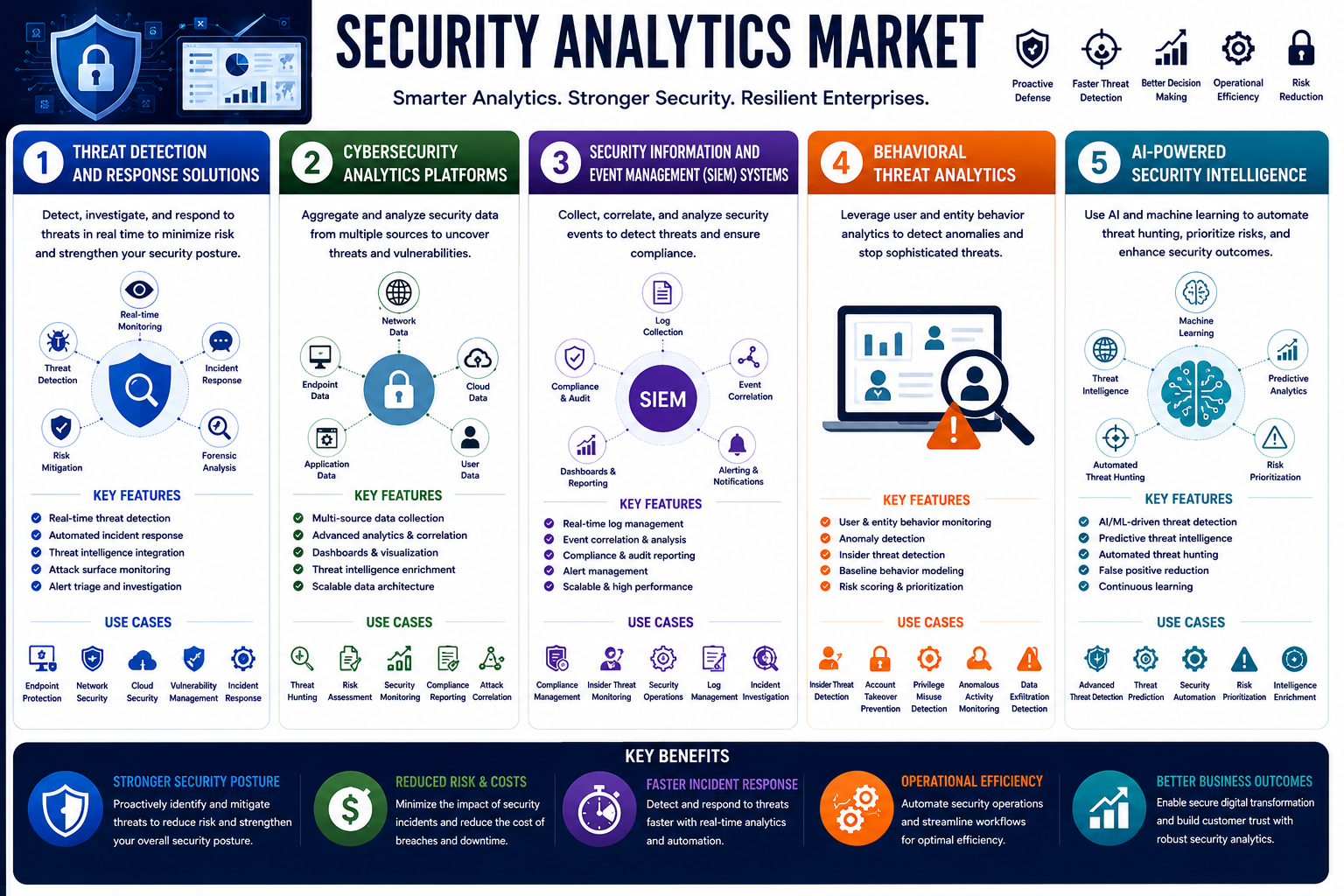
Traditional security tools are designed to detect known threats using signatures and rules. These tools are ineffective against insider threats, compromised accounts, and attacks that use legitimate credentials. According to recent industry research, Behavioral Threat Analytics is addressing this gap by focusing on anomalies in user and entity behavior. This approach enables organizations to detect threats that would otherwise evade detection.
The Security Analytics Market is growing at a CAGR of approximately 14.38%, with the behavioral analytics segment experiencing rapid adoption . The exploitation of legitimate credentials represented 44.7% of data breaches in 2023, highlighting the critical need for behavioral analysis . Organizations are increasingly investing in solutions that can detect subtle deviations from normal behavior patterns.
How Behavioral Threat Analytics Works
Behavioral threat analytics establishes baselines of normal activity for users, devices, and applications. It continuously monitors for deviations from these baselines that may indicate malicious activity. When a user accesses sensitive data at unusual hours or downloads excessive amounts of information, the system flags the activity for investigation. Advanced platforms use machine learning to refine baselines continuously, adapting to changes in user behavior.
A retail company might use behavioral analytics to protect customer data. The system monitors employee access to the customer database. When a legitimate employee downloads an unusually large number of customer records outside business hours, the system triggers an alert. Security investigates and discovers that the employee's credentials have been compromised.
Security Information and Event Management Systems for Correlation
Security Information and Event Management Systems provide the event correlation capabilities that make behavioral analytics effective. By connecting behavioral anomalies with other security events, SIEMs provide context that helps security teams distinguish between true threats and false positives.
A healthcare system might combine behavioral analytics with its SIEM to detect insider threats. The SIEM correlates unusual access patterns with other events, such as failed login attempts or data transfers. This correlation reveals a coordinated attack, enabling rapid response.
Drivers: Insider Threats and Credential Abuse
The rising incidence of insider threats and credential abuse is a primary driver for behavioral analytics. In 2023, the exploitation of legitimate credentials represented 44.7% of data breaches . The average cost of a data breach reached $4.88 million, representing a 10% rise from 2023 . These figures underscore the critical need for behavioral analytics to detect threats that evade traditional security measures.
AI and Machine Learning Integration
Behavioral analytics relies heavily on AI and machine learning. These technologies enable the system to analyze vast amounts of data and identify subtle patterns that may indicate malicious activity. AI-driven security analytics solutions processed 2.3 trillion data points daily in 2024, reducing threat detection time by 47% compared to traditional methods . Organizations are increasingly adopting ML-based analytics to improve accuracy in identifying advanced threats.
Compliance Mandates
Regulatory compliance mandates are also driving adoption of behavioral analytics. Organizations face significant penalties for data breaches and non-compliance. Security analytics tools help organizations detect unauthorized access and ensure adherence to regulatory standards through comprehensive auditing and reporting capabilities. In 2024, 85% of global organizations reported increased investment in compliance-driven security solutions .
Addressing the Talent Shortage
Behavioral analytics also helps address the cybersecurity talent shortage by automating threat detection and prioritization. With over 50% of security teams feeling understaffed, automation is essential for managing the growing volume of security telemetry . AI-driven analytics can reduce false positives by over 60%, enabling analysts to focus on critical threats .
Regional Growth
North America leads in behavioral analytics adoption, driven by high digital adoption and strict regulatory environments. Asia-Pacific is expected to be the fastest-growing region

 Arabic
 French
 Spanish
 Portuguese
 Deutsch
 Turkish
 Dutch
Dutch
 Italiano
 Russian
 Romaian
 Portuguese (Brazil)
 Greek
Greek