


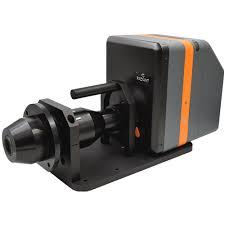
For B2B manufacturers of micro-OLEDs, automotive displays, and AR/VR optics, the conoscope lens (or Fourier lens) is indispensable for mapping luminance and chromaticity as a function of viewing angle. Yet, in high-volume production, the transition from static R&D testing to automated optical inspection (AOI) frequently fails.
The problem isn't the lens's ability to capture a 160-degree cone of light; it’s the data integrity and alignment sensitivity that occur when these systems are integrated into a 24/7 industrial workflow.
1. The Vignetting and Cosine-Fourth Law Compensation
A primary technical failure in conoscope systems is the drop-off in measurement accuracy at the edges of the field of view (FOV).
-
The Issue: Due to the cos4(θ) law of illumination, light intensity naturally falls off as the angle of incidence increases. In many B2B setups, this results in "dark edges" in the viewing angle map.
-
The Conflict: If the software calibration doesn't perfectly match the specific physical aperture of the conoscope lens, the system will report false "uniformity errors" in the display being tested.
-
The Solution: Engineering teams must move beyond standard factory calibration and implement real-time vignetting correction based on a reference Lambertian light source. This ensures that the ±80° measurement is as photometrically accurate as the 0° center point.
2. Stray Light and Contrast Floor Contamination
In the pursuit of high-dynamic-range (HDR) displays, the "contrast floor" of the measurement tool itself becomes the limiting factor.
-
The Problem: Internal reflections within the conoscope lens elements—often called "lens flare" or "veiling glare"—can contaminate the measurement of a "black" pixel when it is adjacent to a "bright" pixel.
-
The Consequence: This creates a false measurement of the display’s contrast ratio. For B2B suppliers to high-end automotive brands, this error can lead to the rejection of perfectly good display batches.
-
The Fix: Solving this requires specifying lenses with advanced broadband anti-reflective (AR) coatings and integrated baffles. Furthermore, the use of a "black mask" test pattern during the QC cycle is necessary to quantify and subtract the system's internal stray light from the final data.
3. The Working Distance and Pupil Alignment Crisis
In AR/VR applications, the conoscope must mimic the human eye's position, often requiring a very specific "entrance pupil" location.
-
The Pain Point: Mechanical misalignment of just 0.5mm between the display's exit pupil and the conoscope's entrance pupil leads to significant measurement distortion and chromatic aberration.
-
The Reality: On an automated production line, maintaining sub-millimeter alignment is difficult due to mechanical vibrations and jig tolerances.
-
Mitigation: The integration of multi-axis robotic positioning with active optical feedback is the only way to resolve this. The system should automatically "hunt" for the peak luminance central ray before commencing the angular sweep to ensure the measurement axis is perfectly perpendicular to the display surface.
Throughput vs. Resolution Trade-off
A common B2B procurement trap is over-specifying angular resolution. While 0.1° resolution is great for R&D, it generates massive datasets that can slow down a production line’s Takt time. The problem is often a software bottleneck—the CPU cannot process the Fourier transform fast enough for 100% inspection. The strategic solution is ROI (Region of Interest) binning, where high resolution is only applied to critical viewing angles, significantly increasing throughput without sacrificing data quality.
Conclusion
The true value of a conoscope lens in a B2B environment is measured by its repeatability and integration stability, not just its theoretical FOV. By addressing the problems of photometric roll-off, internal stray light, and mechanical alignment precision, manufacturers can turn their display metrology from a production bottleneck into a competitive advantage. In the high-stakes world of display manufacturing, the goal isn't just to see the light—it's to measure it with absolute, unshakeable certainty.

 Arabic
 French
 Spanish
 Portuguese
 Deutsch
 Turkish
 Dutch
Dutch
 Italiano
 Russian
 Romaian
 Portuguese (Brazil)
 Greek
Greek