


The Opportunity Is Bigger Than One-Time Bookings
A leaking tap, an office that needs assembling, a rental property awaiting repairs, or a household preparing for a move—these needs arise every day, but customers do not always know whom to contact. Finding a reliable professional can involve several calls, uncertain prices, and wasted time.
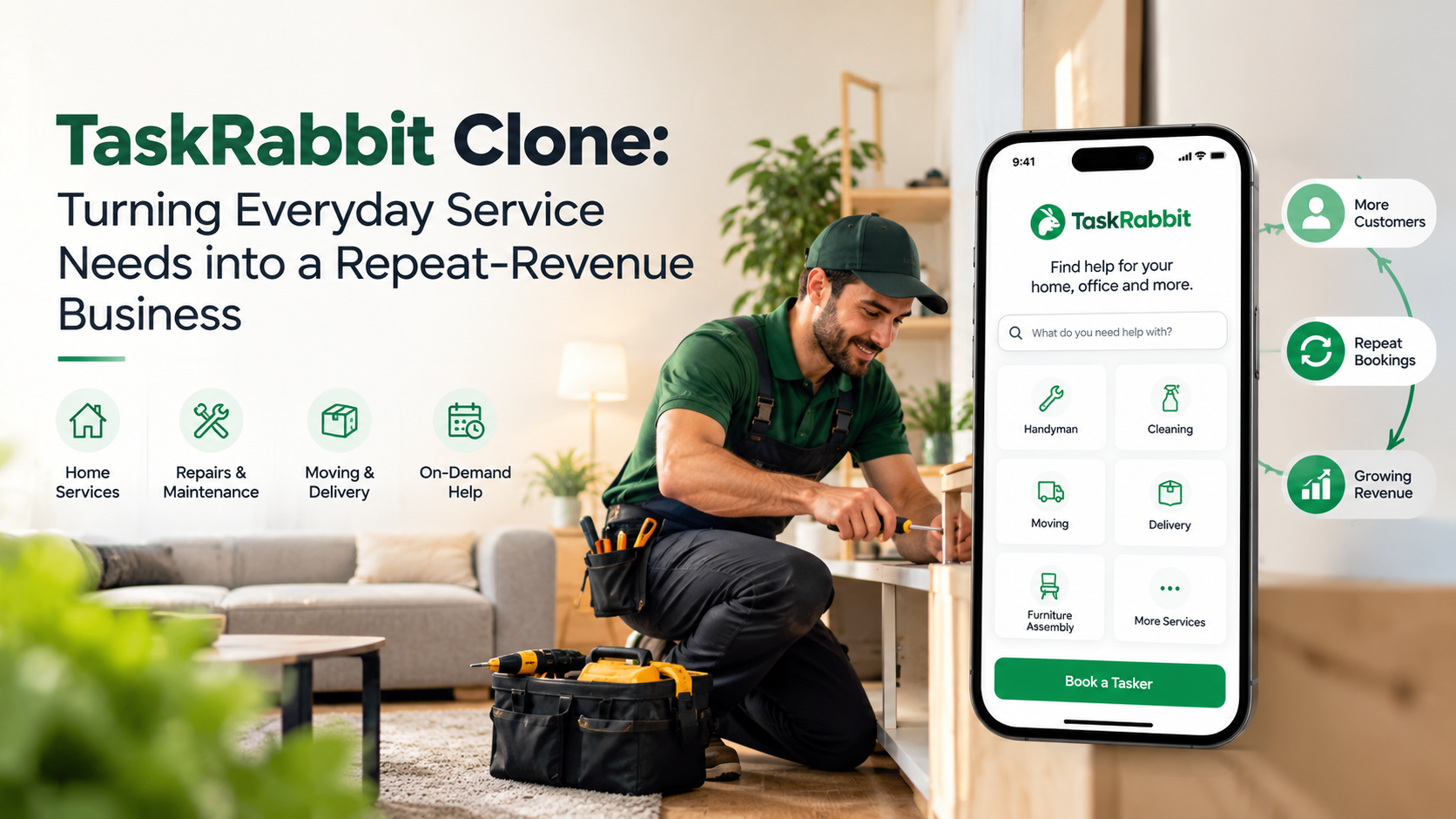
For entrepreneurs, this gap creates a business opportunity. A TaskRabbit clone can provide the digital foundation for a marketplace that connects customers with local service professionals and makes booking, scheduling, and payment more convenient.
The commercial opportunity lies in understanding what customers need repeatedly, not simply creating a platform that lists available workers.
Why Repeat Demand Matters More Than Download Numbers
Many marketplace businesses focus heavily on acquiring new users. However, downloads alone do not create a sustainable business. Customers must return, providers must receive worthwhile assignments, and completed jobs must generate enough revenue to support operations.
Consider a platform serving landlords and property managers. They may need cleaning after tenants move out, furniture assembly, routine maintenance, and occasional repair work. Instead of treating every request as an isolated transaction, the marketplace can develop ongoing relationships with these customers.
Similarly, busy households may regularly require cleaning, gardening, appliance installation, and minor repairs.
These use cases create opportunities for repeat bookings, service packages, and business accounts. A TaskRabbit clone can help organize these transactions within a single platform.
Find the Right Customers Before Expanding Services
A broad service marketplace may look attractive, but managing numerous categories from day one can make provider recruitment, quality control, and customer acquisition more complicated.
A more focused launch strategy begins with a specific customer problem.
Property management: Connect landlords and property managers with professionals for turnover cleaning, minor repairs, and maintenance tasks.
Busy households: Make everyday jobs such as furniture assembly, mounting, and home organization easier to arrange.
Small businesses: Help offices, retail stores, and other commercial spaces access flexible maintenance and installation services.
Each segment offers a different path to market. Business customers may value scheduled appointments and consolidated billing, while households may prioritize quick booking, reviews, and transparent pricing.
Choosing a primary audience makes it easier to design relevant services, communicate value, and identify effective marketing channels.
Make Provider Availability a Competitive Advantage
In a service marketplace, customer demand means little if suitable professionals are unavailable when needed. Provider availability is therefore a business issue as much as an operational one.
A well-planned TaskRabbit clone should support provider registration, service-area selection, working-hour management, job acceptance, and booking notifications. Customers should be able to understand the service scope, expected timing, and pricing before confirming a request.
Location-based discovery can help customers find suitable professionals nearby. Scheduling tools can help reduce appointment conflicts, while booking status updates keep both parties informed.
The business must also establish clear expectations around cancellations, late arrivals, customer complaints, and incomplete jobs.
Reliable fulfillment creates a stronger foundation for reviews and repeat purchases than simply adding more providers to a directory.
Build Revenue Around the Value Delivered
A service marketplace can generate revenue in several ways, depending on its audience and operating model.
-
Booking commissions: Earn a percentage or agreed fee from completed jobs.
-
Customer service fees: Charge a clearly disclosed fee for facilitating a booking.
-
Provider subscriptions: Offer paid plans where professionals receive valuable business tools or suitable lead opportunities.
-
Recurring service packages: Support repeat cleaning, maintenance, or other scheduled services.
-
Business accounts: Serve property managers and small companies with ongoing service requirements.
The best model depends on the market. High commissions may reduce provider participation, while excessive customer fees can discourage bookings. Subscription plans also need to offer value that customers or providers can clearly recognize.
Founders should track completed bookings, repeat customer rates, average transaction value, provider retention, customer acquisition costs, and profit per transaction. These metrics help determine whether the marketplace is growing sustainably.
Technology Should Remove Friction from the Job
Customers do not use a service marketplace because it has the most buttons. They use it because booking a suitable professional becomes easier.
Useful capabilities include straightforward service selection, clear provider profiles, secure payments, ratings, notifications, and efficient job management. Automated matching can help identify suitable professionals based on location, skills, availability, and customer requirements.
AI-assisted support or recommendations may improve the experience as the marketplace grows, but these features should address identifiable customer or operational problems rather than exist merely as marketing claims.
Trust remains equally important. Professional verification, transparent policies, and a reliable complaint-resolution process help reduce uncertainty for customers and providers.
Launch Locally, Learn Quickly, and Scale Carefully
A practical launch begins with one defined area and a manageable range of services. Recruit qualified professionals, establish service standards, and attract an initial group of customers through local partnerships, search marketing, and referral programs.
Early performance should guide expansion. If furniture assembly and maintenance generate consistent bookings, related services may be a sensible next step. If demand is irregular or providers frequently decline jobs, the business should address those problems before entering another category.
This approach helps founders build marketplace activity around real demand instead of spreading resources too thinly.
Build Your Service Marketplace with spotnrides
For entrepreneurs planning to enter the on-demand services market, spotnrides offers a TaskRabbit clone app that provides a starting point for building a branded service marketplace.
The business opportunity extends beyond launching software. It involves selecting the right customer segment, building a dependable provider network, choosing a workable revenue model, and creating an experience that encourages repeat bookings.
A strong TaskRabbit clone business is built when customers know where to find reliable help and service professionals have a practical way to win more work. Focus on that exchange, prove the model in one market, and expand when the results support it.

 Arabic
 French
 Spanish
 Portuguese
 Deutsch
 Turkish
 Dutch
 Italiano
 Russian
 Romaian
 Portuguese (Brazil)
 Greek