


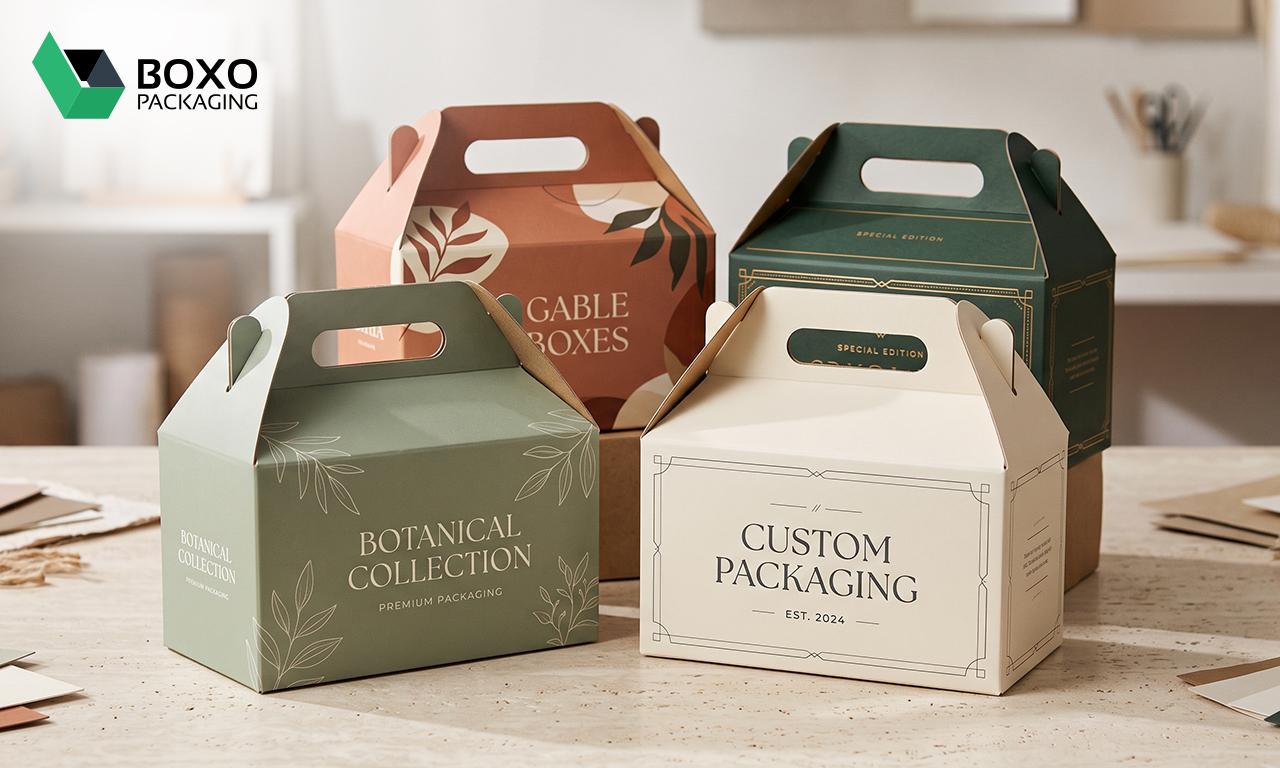
A carry-top carton begins as a folding paperboard blank, but its roof panels and interlocking handle determine how someone picks it up. Custom Gable Packaging adjusts that construction to the actual contents: their footprint, height, weight, and required presentation. Its purpose is not simply to add a handle. A suitable design allows the package to be filled, closed, carried and opened without crushing the product or stretching the handle tabs.
Sizing the Carton Around the Contents
A rectangular base must fit the packed item rather than its unwrapped dimensions. Tissue, cushioning or dividers consume space that a quick product measurement can miss. Designers also need clearance around taller items so the sloping roof closes without touching a delicate lid or decoration.
The handle is a load-bearing detail. Paper grain, die-cut shape and the amount of board around finger openings affect how it behaves when lifted. A filled prototype should be carried by its handle, including a short walk and a few turns, before a production order is approved.
Buyers sometimes request thicker board as the first solution to poor strength. That is not always effective. Reinforcing the base, changing the fold geometry or redistributing the contents may address the actual failure more directly. The correct decision follows a loaded sample test and a conversation about the intended journey.
For bakery gifts, food should be enclosed in a suitable primary wrap or food-contact liner when needed. An attractive printed outer carton alone does not establish that inks, coatings or adhesive surfaces are appropriate for direct food contact. The packaging arrangement should reflect the product and applicable food-contact requirements.
Planning Artwork Around Folds and Panels
Custom printing works across the broad front and side panels, yet folds interrupt a design. Important text should stay away from score lines, handle cutouts and areas hidden after assembly. A subtle uncoated finish may suit rustic gift assortments; coated board can reproduce detailed artwork more consistently.
A production dieline deserves its own review. It records cut lines, crease positions, glue areas and safe zones for print. Suppliers may provide digital proofs, but those cannot demonstrate whether a full container rubs against the roof or whether the handle pinches a hand. The last approval should therefore follow physical assembly with every planned component included.
- Check the filled package weight before choosing the handle and base style.
- Use a full-size mockup to confirm roof clearance above the contents.
- Keep barcode and essential instructions on uninterrupted readable panels.
- Test how quickly staff can form the base and lock the top.
The final decision depends on the packing workflow as much as the printed artwork. A two-item promotional kit may need a partition; a tall favor set may need a lower insert that limits tipping. A sample from Boxo Packaging or any other supplier should be evaluated with the actual filled product, not as an empty display piece. With Custom Gable Packaging, small adjustments to the structure can prevent expensive handling problems after printing.
How Are Custom Tuck Boxes Structured for Everyday Use?
Small retail items often need a carton that closes firmly while remaining simple to open. Custom Tuck Boxes use folding flaps inserted into the carton opening, generally supported by dust flaps at the sides. Their relatively flat blank is convenient to store, and the finished rectangular shape stacks neatly. The fit of the flap is crucial: a loose tuck opens too readily, while an overly tight one can crease the front panel.
Choosing the Right Tuck-Flap Structure
Straight-tuck designs orient end flaps in the same direction; reverse-tuck cartons alternate the directions. Selection can depend on artwork layout, die efficiency, packing method and the appearance of the main display face. Neither arrangement should be chosen from the name alone.
A fragrance vial and a deck of cards may share an outer shape but demand different internal support. Card decks tolerate fairly close wall contact; glass products often benefit from a board cradle or other engineered insert. Product measurements should include caps, dispensers and protective wrapping.
Shelf geometry is important even for products that look impressive in photographs. A hanging tab, retail tray or display insert may dictate how the front face should be oriented. Check the placement of all these accessories early, because a later change can alter the dieline and make established artwork unusable.
Making Reopening Easy for Customers
Reopening changes the evaluation. Products such as sample kits, craft supplies and personal-care items are handled after purchase, sometimes repeatedly. A thumb notch can help the customer open the carton without tearing it, but any opening feature must be compatible with tamper-evidence requirements if such controls apply.
Coating and print decisions have practical effects. Heavy varnish along a fold can crack when the carton is assembled. Metallic foil near a score may be vulnerable to distortion. Artwork proofing should consider both a flattened dieline and a physical sample under ordinary shop lighting.
For multipacks, test the direction in which weight shifts when carried. Tall bottles may lean inward while flat items can migrate toward one side. A small folded partition often does more for the carrying experience than thicker outer board alone. It keeps the center of mass predictable and makes a gift look organized on opening.
- Choose a flap arrangement that works with the planned packing process.
- Reserve enough depth for inserts, not only the saleable product.
- Prototype the first opening and repeated closing experience.
- Verify fine text and finishing effects on creased sample panels.
A tuck carton is often a better answer than a handled box for densely packed shelf items because it uses less vertical space and offers a familiar opening. Conversely, carry-top packaging is easier to hand to guests at an event. Custom Tuck Boxes earn their place when protecting, identifying and dispensing a compact item matters more than transport by a built-in handle.

 Arabic
 French
 Spanish
 Portuguese
 Deutsch
 Turkish
 Dutch
 Italiano
 Russian
 Romaian
 Portuguese (Brazil)
 Greek