


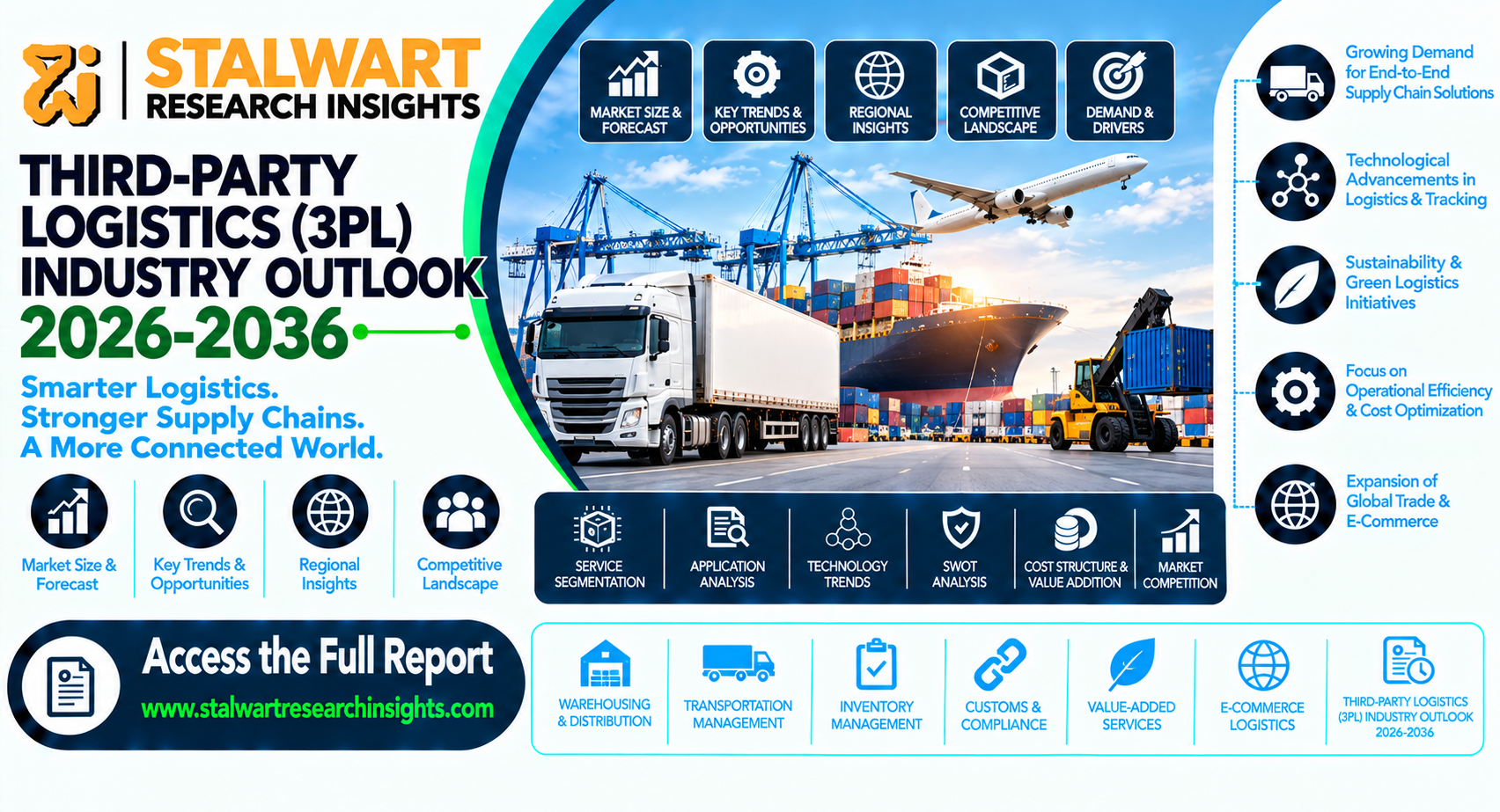
Overview of the Market:
The global third-party logistics market is gaining importance as businesses seek flexible, cost-effective, and reliable supply chain solutions. Third-party logistics providers manage services such as transportation, warehousing, freight forwarding, distribution, inventory management, and order fulfillment on behalf of manufacturers, retailers, and other organizations.
Technological advancements are transforming the industry through artificial intelligence, warehouse automation, real-time shipment tracking, cloud-based logistics platforms, and data-driven route optimization. Providers are investing in integrated supply chain solutions, last-mile delivery capabilities, and specialized services for healthcare, automotive, food, and consumer goods.
Industry Insights: Scale, Segments, and Shifts
Market Size & Growth: The global third-party logistics (3PL) market is projected to reach USD 3,626 Bn by 2036, registering a CAGR of 9.2% between 2026 and 2036.
Access the Full Report PDF Here:
https://www.stalwartresearchinsights.com/request-sample/third-party-logistics-pl-industry-outlook
Key Market Trends:
-
Growing outsourcing of logistics and supply chain management services.
-
Increasing demand for e-commerce fulfillment and last-mile delivery.
-
Adoption of AI-powered logistics planning and predictive analytics.
-
Expansion of automated warehouses and smart inventory management.
-
Growing use of real-time shipment tracking and supply chain visibility platforms.
-
Rising demand for integrated transportation and warehousing services.
-
Increasing focus on sustainable logistics and low-emission transportation.
-
Expansion of cold chain logistics for food, pharmaceuticals, and healthcare products.
Analytical Tool:
-
SWOT Analysis: Evaluates industry strengths, weaknesses, opportunities, and threats.
-
PESTEL Analysis: Examines political, economic, social, technological, environmental, and legal factors.
-
Porter's Five Forces: Analyzes competitive rivalry, supplier power, buyer power, new entrants, and substitutes.
-
Value Chain Analysis: Examines transportation, warehousing, inventory management, distribution, and delivery.
-
Market Segmentation Analysis: Evaluates service types, transport modes, end-use industries, and regions.
-
Competitive Benchmarking: Compares major providers based on service portfolios, technology adoption, geographic reach, and operational capabilities.
Regional Analysis:
-
North America: Demand is supported by established logistics networks, advanced warehouse automation, e-commerce fulfillment, and integrated supply chain services.
-
Europe: Cross-border trade, digital logistics platforms, sustainability initiatives, and multimodal transportation support market development.
-
Asia-Pacific: Manufacturing growth, expanding e-commerce, international trade, and infrastructure investments create significant opportunities for 3PL providers.
-
Middle East and Africa: Logistics hubs, free-trade zones, infrastructure development, and investments in distribution networks support regional expansion.
-
South America: Growing retail activity, cross-border commerce, and modernization of transportation and warehousing infrastructure create opportunities.
SWOT Analysis:
-
Strengths: Specialized logistics expertise, scalable services, established transportation networks, and potential cost efficiencies.
-
Weaknesses: Dependence on external service providers, complex coordination, and limited direct control over outsourced operations.
-
Opportunities: E-commerce logistics, warehouse automation, cold chain services, AI-based optimization, and sustainable transportation.
-
Threats: Fuel price volatility, intense competition, cybersecurity risks, labor shortages, and supply chain disruptions.
PESTEL Analysis:
-
Political: Trade policies, customs procedures, infrastructure investments, and international trade agreements.
-
Economic: Fuel prices, labor costs, inflation, freight rates, and fluctuations in global trade.
-
Social: Rising consumer expectations for faster delivery, shipment transparency, and reliable order fulfillment.
-
Technological: Artificial intelligence, robotics, cloud logistics platforms, IoT tracking, and predictive analytics.
-
Environmental: Pressure to reduce transportation emissions, optimize fuel consumption, and adopt sustainable packaging and distribution practices.
-
Legal: Customs compliance, transportation regulations, data protection requirements, labor laws, and international shipping standards.
Market Share:
-
Transportation Services: A major component of 3PL operations, covering road, rail, air, and maritime freight movement.
-
Warehousing and Distribution: Supports inventory storage, order processing, fulfillment, and product distribution.
-
Dedicated Contract Logistics: Provides customized logistics operations under long-term service agreements.
-
Freight Forwarding: Coordinates international cargo movement, shipping documentation, and multimodal transportation.
-
E-commerce and Retail: Generates demand for order fulfillment, returns management, and last-mile delivery.
-
Healthcare and Pharmaceuticals: Creates specialized requirements for temperature-controlled transportation, traceability, and regulatory compliance.
-
Regional Share: Market leadership varies by service category and geography; current report-specific regional percentages should be verified against the full report.
Key Players:
-
DHL Supply Chain
-
Kuehne + Nagel International AG
-
DSV A/S
-
C.H. Robinson Worldwide, Inc.
-
GXO Logistics, Inc.
-
CEVA Logistics
-
Nippon Express Holdings, Inc.
-
Ryder System, Inc.
-
UPS Supply Chain Solutions
-
FedEx Logistics
-
DB Schenker
-
XPO, Inc.
Challenges:
-
Fluctuating fuel prices and rising transportation costs.
-
Labor shortages and increasing workforce expenses.
-
Supply chain disruptions and international shipping delays.
-
Complex customs procedures and cross-border regulations.
-
High investment requirements for automation and digital infrastructure.
-
Cybersecurity risks and data integration challenges.
-
Pressure to improve delivery speed while maintaining profitability.
Future Opportunities:
-
Expansion of e-commerce fulfillment and last-mile delivery services.
-
Greater adoption of AI-powered transportation management systems.
-
Development of automated warehouses and robotic order fulfillment.
-
Growth in pharmaceutical and temperature-controlled logistics.
-
Increasing demand for integrated end-to-end supply chain solutions.
-
Expansion of reverse logistics, returns processing, and product recovery.
-
Adoption of electric fleets and low-emission logistics operations.
Browse Trending Report:
- Battery Case Industry Outlook 2026–2036
- Automotive Lead Acid Battery Industry Outlook 2026–2036
- Air Suspension Industry Outlook
- Aircraft Interior Lighting Industry Outlook
- Aluminium Alloys Industry Outlook 2026–2036
- All-Terrain Vehicle Industry Outlook
Conclusion:
The third-party logistics market is evolving as businesses prioritize supply chain flexibility, operational efficiency, and reliable delivery services. Growing e-commerce activity, international trade, warehouse automation, and demand for integrated logistics solutions are creating new opportunities for service providers.
Contact Us:
Stalwart Research Insights
Website: https://www.stalwartresearchinsights.com

 Arabic
 French
 Spanish
 Portuguese
 Deutsch
 Turkish
 Dutch
 Italiano
 Russian
 Romaian
 Portuguese (Brazil)
 Greek